








Indiana Ban Ends Sweepstakes Casino Access July 2026
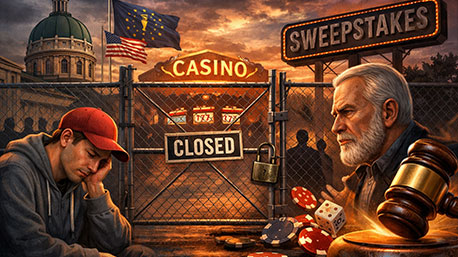
Indiana will restrict access to online sweepstakes-style casino platforms beginning July 1, 2026, following the approval of House Bill 1052 by Governor Mike Braun. The new law targets internet-based gaming systems that allow users to exchange virtual currencies for cash or similar rewards, placing limits on a model that has grown in popularity across several U.S. markets.
Law Defines Limits on Sweepstakes Casino Models
The legislation introduces a clear prohibition on platforms that operate using dual- or multi-currency systems tied to redeemable prizes. Operators that continue offering such services to users in Indiana face financial penalties of up to $100,000 per violation, with enforcement handled by the Indiana Gaming Commission.
The scope of the ban covers a wide range of formats commonly associated with sweepstakes-style gaming. These include slot-like experiences, poker variations, bingo formats, table-style games, lottery-type contests, and sports wagering simulations. At the same time, the law excludes certain categories. Games operated by the state lottery commission remain permitted, along with peer-to-peer poker formats that rely on skill-based interaction between players.
Earlier drafts of House Bill 1052 included provisions for criminal penalties against operators. However, lawmakers removed those elements before final approval. The adopted version focuses on civil enforcement, emphasizing regulatory control and access restrictions rather than criminal prosecution.
The legislative process moved quickly through both chambers. The House first approved the measure with an 87-11 vote on February 2, followed by Senate approval at 37-8 on February 18. After a conference committee addressed minor revisions, both chambers passed the final version again, with the Senate voting 46-4 and the House 68-21, clearing the way for the governor’s signature.
Player Access and Industry Response
The change will alter how players in Indiana engage with digital gaming platforms. Individuals who regularly accessed sweepstakes-style casinos for entertainment will no longer be able to use these services once the law takes effect. This shift affects not only gameplay availability but also ongoing features tied to user accounts, such as balances and promotional campaigns, which may require adjustments as operators comply with the new requirements.
Industry representatives have responded critically to the decision. The Social Gaming Leadership Alliance (SGLA), which represents operators including Chumba Casino, Luckyland Slots, Pulsz, Modo Casino, McLuck, and HelloMillions, expressed concern about the direction taken by lawmakers.
SGLA Managing Director Sean Ostrow said, “We are disappointed that HB 1052 has become law, but are grateful to the many Indiana lawmakers who engaged thoughtfully on the merits of regulating this long-standing industry. Despite the outcome, the legislative record shows meaningful bipartisan support for a smarter approach that embraces innovation and economic growth. We look forward to continuing to work with Indiana lawmakers on a regulatory framework for digital entertainment that protects the hundreds of thousands of Hoosiers that enjoy Social Plus games, while generating tens of millions in annual tax revenue.”
Operators now face decisions on whether to withdraw services from the state or adjust their offerings to align with the legal framework. For players, the immediate impact centers on reduced access to platforms that combine entertainment with prize-based mechanics.
Broader Regulatory Direction Across States
Indiana’s decision reflects a wider pattern emerging across multiple jurisdictions in the United States. Lawmakers in Tennessee are evaluating measures that would categorize sweepstakes-style gaming as deceptive or unfair practices under consumer protection rules. In Oklahoma, proposals under discussion would introduce stricter penalties, with certain violations potentially classified as Class C2 felonies.
These developments indicate increasing regulatory attention on platforms that operate in a space between social gaming and traditional gambling. Authorities are examining how these models function, particularly where virtual currencies intersect with real-world value.
The Indiana legislation places emphasis on maintaining oversight of digital gaming formats that resemble casino-style products while operating outside established regulatory structures. It also raises questions about consistency between states and how enforcement approaches may differ across jurisdictions.
As more states evaluate similar measures, the legal status of sweepstakes-style gaming continues to evolve, shaping how both operators and players interact with these platforms in the future.
Source:
Indiana Sweepstake Casino Ban Impacts Players, LCB.org, March 16th, 2026.