







EU Scrutiny Grows over Malta Bill 55 Gambling Framework Case
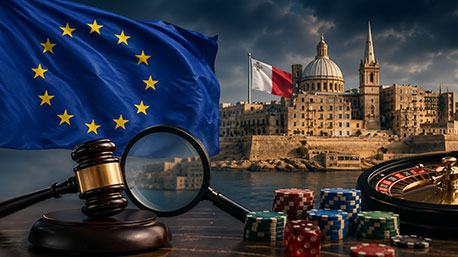
European institutions have stepped up attention on Malta’s Bill 55, a framework built to shield locally licensed gambling operators from foreign court decisions. At the center is Article 56A, introduced in 2023, which instructs Maltese courts to refuse enforcement of overseas judgments when operators acted in line with Maltese law.
Malta defends the rule by pointing to the public policy clause in the Brussels I Recast Regulation. EU bodies, however, see things differently. The European Commission launched an infringement action in June 2025, arguing that Malta stretches the public policy exception beyond what EU law allows and weakens cooperation between national courts.
The dispute has drawn in several member states, with Germany taking a leading role in challenging how the framework works in practice. Austria, the Netherlands, and Sweden have also been involved in related disputes tied to cross-border gambling services and enforcement of player claims.
Questioning the Article 56A Approach
On April 23, 2026, Advocate General Nicholas Emiliou issued an opinion linked to a case from Austria, C-683/24 Spielerschutz Sigma. While the referral itself was ruled inadmissible because it focused on the conduct of a legal adviser, he still addressed the wider legal question behind it.
He said a rule like Article 56A does not fit with EU rules on recognising and enforcing judgments across member states. In his view, courts in Malta should generally recognise and enforce decisions issued elsewhere in the EU, even when they involve disputes against Malta-licensed operators.
He also rejected the idea that a Maltese licence gives operators the right to offer services across the EU. His comments mark the third time he has taken a similar position on the matter. While his opinion is not binding, it often signals how the Court of Justice may rule later.
Wider Gambling Dispute
A separate Court of Justice ruling on April 16, 2026, added more context to the debate. In a case involving a German player, the court confirmed that member states can restrict online gambling services even if those services are authorised in another EU country. It also confirmed that players can pursue repayment claims under national law and that using unlicensed services does not automatically breach EU law.
Much of the legal friction has played out in Germany and Austria, where regulators have questioned Malta’s approach to licensing and enforcement protection.
The economic weight behind the debate is significant. Malta’s gaming sector generated €1.386 billion in gross value added in 2024. It accounted for 6.7 percent of the country’s economy directly, rising to over 10 percent when indirect effects are included.
A final ruling from the Court of Justice will decide whether Article 56A can stand under EU law, a decision that could reshape how cross-border gambling disputes are handled across the bloc.
Malta studies legal framework for prediction markets
Malta is reviewing how to regulate prediction markets as officials assess a legal framework for the fast-growing sector. Economy Minister Silvio Schembri said discussions are underway on how platforms could operate under clear rules, speaking at the opening of Blockchain.com’s Malta offices.
Prediction markets let users trade on outcomes like elections and economic results. Platforms as Polymarket and Kalshi have expanded, with trading estimated at $37bn in 2025 projections above $40bn, while Kalshi is valued at nearly $20 bn. The EU has no unified rules, Malta is considering safeguards, capital rules, market integrity standards, building on earlier gaming and blockchain regulation.
Stricter Oversight for Gaming and Crypto Payments
The Malta Gaming Authority (MGA) has set out its supervisory priorities for 2026, focusing on tighter monitoring of online gambling, crypto payments, and sports betting risks. The plan is detailed in its Supervisory Engagement Efforts for 2026 report, which builds on regulatory work carried out in 2025 and uses risk-based analysis to guide inspections and enforcement.
Malta continues to host a large cluster of gaming firms, including SOFTSWISS, EveryMatrix, Casumo, Betiton, Tipico, Mr Green under Evoke, as well as Betsson, Kindred, and LeoVegas. With such a dense market, the MGA is prioritising compliance checks, player protection, and betting integrity.
Payment oversight is a key area, especially for cash transactions and cryptocurrency use. The regulator will review how operators track deposits and withdrawals and assess controls linked to crypto transfers, which can be harder to trace without strong systems in place.
Sports betting will also face closer scrutiny, including athlete involvement in betting activity and potential integrity risks in esports markets.
Source:
EU Scrutiny Grows Over Malta’s Bill 55 Framework, realmoneyaction.com, April 27, 2026